
Forget haunted houses, creaky floorboards, and that one neighbor who hands out toothbrushes. The scariest thing in podcasting is publishing a great episode… and hearing nothing back but crickets.
Podcast discovery is the monster under every creator’s bed. You can be consistent and do everything quote-on-quote right, but if new listeners can’t find your show, it may as well be locked in a crypt.
The good news? Podcast discovery isn’t some weird hex you have to decode. Discovery is largely built on a sustainable system. And like any good spell, it works best when you know the ingredients before you whip up a brew.
So strap on your Proton Packs. This Halloween, we’re sharing six scary good tips for podcast discovery, from getting started with video to summoning listeners from far beyond your feed.
Read on…if you dare.
Why Podcast Discovery Is the Real Horror Story
Podcasting doesn’t live in one place anymore. More and more, podcasts are materializing beyond our beloved RSS feed, which is great for consumption, but is more daunting for creators.
Once upon a time (cue spooky organ music), getting discovered meant ranking on charts and being good enough to get word of mouth. Today, however, listeners find shows everywhere: on YouTube, in social feeds, through search, through friends, and increasingly through AI chatbots.
That’s a lot of paths for a listener to wander down. It’s also a lot of places you need to be to maximize opportunity.
Audiences don’t stay put, either. Cumulus found that while YouTube leads consumption, 58% of people reported listening to those same shows in other places. The point is, listeners roam, and a show that only lives in one place misses those wandering spirits…er, ears!
Add in algorithms that reward consistency, a never-ending supply of new shows, and a to-do list already stuffed with recording, editing, and booking guests, and it’s no wonder discovery feels like something that goes bump in the night.
But like any good horror movie, there’s a survivor’s guide that, shockingly, isn’t in the dimly lit basement. The six tips below break podcast discovery into manageable pieces, so you can show up in more places without spreading yourself thin.
Tip #1: Don’t Ghost YouTube 👻
If your podcast isn’t on YouTube, you’re likely missing out on some serious podcast discovery opportunities.
YouTube is now the #1 platform for podcast consumption. And the audience is massive: YouTube reports more than 1 billion monthly active viewers of podcast content. That’s a lot of potential listeners in one place.
The opportunity doesn’t end on YouTube, either. As YouTube is owned by Google, YouTube videos regularly and organically appear in Google search results. There’s even a ‘video’ tab in Google search options! By uploading your episodes to YouTube, your podcast can appear not only on YouTube, but in search results as well.
Size is only part of the appeal, too. YouTube is built for discovery. The app is designed to keep people engaged, constantly feeding them recommendations based on their profile and activity. All of that is great and wonderful, but how do you make sure your show makes the cut?
Here’s how to make sure your show isn’t haunting an empty house:
- Create a YouTube Podcast Playlist. This tells YouTube (and its algorithm) that your uploads are podcast episodes. YouTube’s help page walks you through setup.
- Upload video when you can. When it comes to YouTube, there is a ‘good, better, best approach.’ This approach ranges from low-lift audiograms to full-scale production. Depending on your bandwidth, show, and resources, how you upload a podcast to YouTube is totally up to you; the important thing is that you do upload it.
- Fill out every metadata field. YouTube and search can’t watch your episode, so they rely on your metadata to do the explaining. Filling out your metadata fields—think titles, descriptions, tags, chapters, transcripts—gives YouTube and search all the information they need to be able to quickly understand, contextualize, and ultimately push your podcast to listeners.
- Brand it and add thumbnails. Just like your episode art, you’ll want to create a distinct visual brand for your podcast. One of the quickest, best ways to do this on YouTube specifically is to make thumbnails. Thumbnails not only build show awareness, but they often serve as the first touchpoint that can quickly grab attention… like a great jump scare!
Bottom line: YouTube is where a huge share of audiences already hang out, and it can also carry your show into Google search. Whether you start with a simple audiogram or go full studio, getting your podcast on YouTube puts it in front of more potential listeners than almost anywhere else.
But uploading full episodes is only the first step. To really get noticed, you need to give people a taste of your show in the places they scroll. Which brings us to our next treat…
Tip #2: Clip Like a Mad Scientist 🧪
Every long-form episode is a laboratory full of short-form specimens waiting to come alive.
In fact, a recent study by our friends at Sounds Profitable unearthed that 89% of listeners watch podcast clips on at least one social platform. 72% of those listeners do so often or always. And, here’s a look at the platform level (for proper dissection):
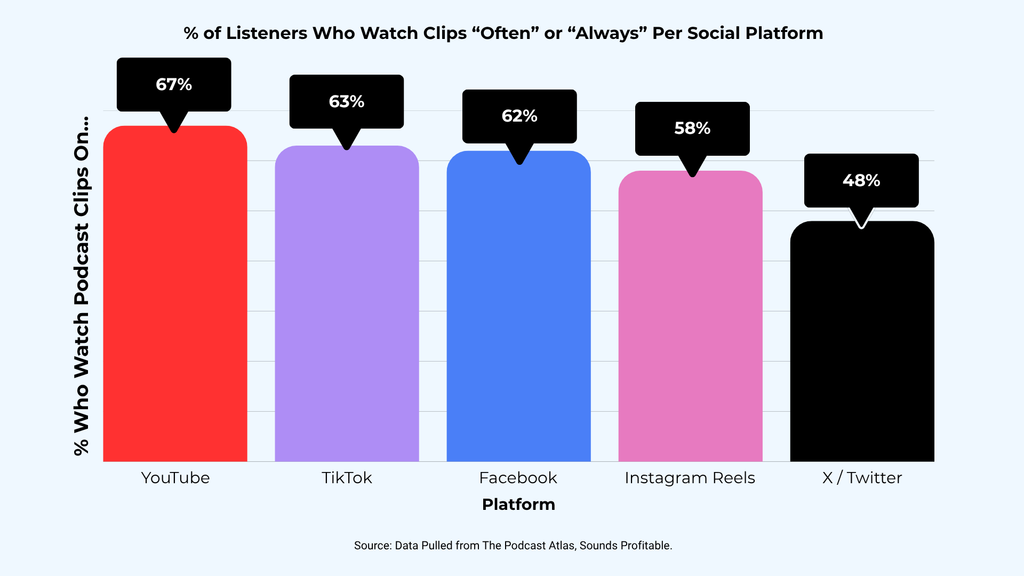
Watching podcast clips has quickly become mainstream. Podcast clips are now more often than not the first taste or impression a new listener gets of your show. A well-constructed clip on YouTube Shorts, Instagram Reels, or TikTok stops passive thumbs dead in their tracks.
One of the biggest problems when it comes to podcast clips? Time! Finding the moments, cutting them, captioning, styling, posting… for many podcasters, making these quick cuts just isn’t what they envisioned when deciding to podcast. Doing yet another task can oftentimes feel like a death sentence for creators, too.
The good news is that many podcast tools have invested in helping offload that unwanted burden. Podcast tools like Headliner, Riverside, and Descript have invested in developing tools to help podcasters brew these spellbinding clips.
What makes a good podcast clip?
Feeling like a mad scientist yourself or just want a look behind the curtain at what makes a good podcast clip? Here are a few things we at Headliner look at to help brew these powerful potions for podcast discovery.
- Hook ’em fast. How well the first few seconds grab attention. When making clips yourself, try things like opening with a bold line, question, or surprise that quickly catches attention.
- Pick a complete moment. A good cliffhanger can work, but in general, when brewing clips, include the full, complete thought. A clip can leave people wanting more, but it should not leave them questioning what they just watched.
- Leave the dry ice at the party. Clips should be clear and easy to follow, not foggy. Try clipping moments with clear, audible conversation.
- Evoke emotion. Good clips make you feel something. Try clipping moments that make viewers laugh, nod along, or just feel something. It not only makes the clip more interesting, but also builds the human connection podcasting is known for.
Again, if you’re feeling up to the task, consider these tips for making a good podcast clip. If you find yourself short on time, consider free podcast video tools like Headliner to do the dirty work for you.
Tip #3: Speak Up… The Algorithm Can’t Hear You 🔮
Here’s a bone-chilling truth: algorithms, search engines, and AI chatbots can’t listen to your podcast. But (extra, extra) they can read all about it.
That means spoken words and incantations need to exist in a way these beings can ingest them. This is where that all-powerful transcription comes in. Transcripts provide a 1:1 written account of everything that was said in the podcast episode. For algorithms, this is the ingredient they need to contextualize and ultimately recommend your podcast for discovery.
And the stakes (not the wooden-dagger ones, but the table ones) are rising. Search and discovery are shifting across the board to include AI. About half of U.S. adults now use AI chatbots. When someone asks a chatbot for “true crime stories in the Midwest” or to “explain personal finance,” that’s another opportunity for a podcast, especially if it is uploaded to YouTube, to be discovered.
Transcripts provide text-based breadcrumbs that algorithms can use to find you, not just floating in the ether.
For more information on podcast transcription, check out this scary good podcast episode on just that!
Tip #4: Haunt More Than One House 🏚️
A good ghost never sticks to just one spot.
YouTube matters, but it’s not the whole neighborhood. Social media reaches more than 5.79 billion users. And, of course, there are traditional podcast platforms like Apple Podcasts and Spotify.
The point is, being in just one place bottlenecks podcast discovery.
And not every audience lives in the same house. Different audiences and listeners live on different platforms. Meaning the people who found your podcast on TikTok are likely not the people who found you on Apple Podcasts. These different ghouls need different stuff. So, if a platform doesn’t seem to be working for your show, it might not be your content. It might be an audience mismatch.
How to spread your haunt without running yourself ragged:
- Pick places where your audience already hangs out. Think about who your ideal listener is. What do they care about? Where might they be online? Really diving into these questions can help you better suss out where your energy should go. And, if you’re not sure, try small, incremental tests to see what gets traction where.
- Test something new. If growth has flatlined on one platform, try shaking things up. Sometimes organic growth has taken you as far as it can for now. Partner with other podcasters or even venture into paid podcast promotion to resurrect growth.
- Engage when people show up. A good ghost and ghoul knows how to rile people up. If you get a reaction, keep that moment! Remind people of your existence by engaging back when you get a hit.
The more houses your show haunts, the more chances for podcast discovery. But even the most well-traveled ghost eventually hits a wall. When organic reach stalls, it may be time to summon some help…
Tip #5: Summon Listeners From Beyond Your Feed 🕯️
Sometimes you do everything right, and your podcast’s growth still feels stuck in purgatory. Don’t worry, your show isn’t damned. A plateau isn’t a failure; it’s a signal that organic reach has taken you as far as it can for now.
Organic strategies depend on algorithms, timing, and the audience you already have. To keep growing, you may need a more intentional, layered approach, one that builds on what’s already working and consistently puts your show in front of new listeners.
That’s where paid podcast promotion comes in. Paid growth amplifies your existing efforts and lets you go find the people who haven’t discovered you yet.
Paid growth works especially well during key moments:
- Season launches and premieres. Give new episodes a running start.
- Big-name guest episodes. Put your best content in front of the most people.
- Rebrands or format changes. Introduce the new look to new ears.
- Growth plateaus. Break out of the same circle of listeners.
The trick is choosing promotion and approach that brings in real people and is a good fit for your show, bandwidth, and audience.
For more on summoning listeners from beyond the feed and to learn more about the world of paid podcast promotion, including the different types of paid growth strategies, check out our three-part guide.
Tip #6: Make It a Year-Round Haunting 🎃
Halloween lasts one night. Podcast discovery shouldn’t.
Consistency signals to listeners and algorithms alike that your podcast is very much alive. Go quiet for too long, and your show starts collecting cobwebs.
But this doesn’t mean you need to build an ‘always-on’ system. In fact, we encourage you not to if you can help it! Constantly creating can lead to burnout and the dreaded podfade.
Instead, try building a sustainable system that keeps your show from ghosting your audience.
- Set a posting rhythm you can actually keep. A steady schedule beats a burst of activity followed by silence.
- Automate the repetitive work. Clips, captions, and uploads shouldn’t depend on you remembering to hit publish. Consider podcast tools like Headliner to automate day-to-day tasks such as video clip and audiogram creation.
- Resurface your back catalog. Evergreen episodes can find new listeners months or even years later. Even if you’re not actively producing new episodes, you can still share and promote older episodes, especially if they’re timely or if you took some time to remaster or update.
- Mix organic and paid. Let automation keep your feeds active, and use paid promotion to reach new audiences at key moments.
- Check what’s working. Look at which clips, platforms, and episodes drive listens. If you see something that’s working particularly well, try and lean into that. Haunting multiple things at once is great, but it truly only works if you can sustain it. Do what you can when you can.
After all, the best hauntings aren’t the loudest; they’re the ones that are consistent and serve as a constant reminder… you’re never really alone. 👻
No Tricks, Just Treats for Podcast Discovery
And there you have it: Headliner’s scary good tips for podcast discovery this Halloween.
- Don’t ghost YouTube
- Clip like a mad scientist
- Speak up, because the algorithm can’t hear you
- Haunt more than one house
- Summon listeners from beyond your feed
- Make it a year-round haunting
Podcast discovery can feel like wandering through a dark forest with a dying flashlight. But it doesn’t have to be a nightmare. When your show is on video, clipped, captioned, posted consistently, and reaching new audiences, discovery stops being a mystery and becomes a system.
From video podcasting tools that get your episodes ready for YouTube, to automations that keep your clips flowing, to Podcast Promo for reaching listeners far beyond your feed, Headliner gives you everything you need to help your show get found.
So this Halloween, skip the séance. Try these tricks for a podcast discovery treat!
🎃 Start growing your show today at headliner.app
This blog was written by a real candy-fueled, pun-powered human and edited with the help of AI.
